History · Grefsheim
The history of Grefsheim
From the earliest traces of people by Lake Mjøsa to the farm as it is run today.
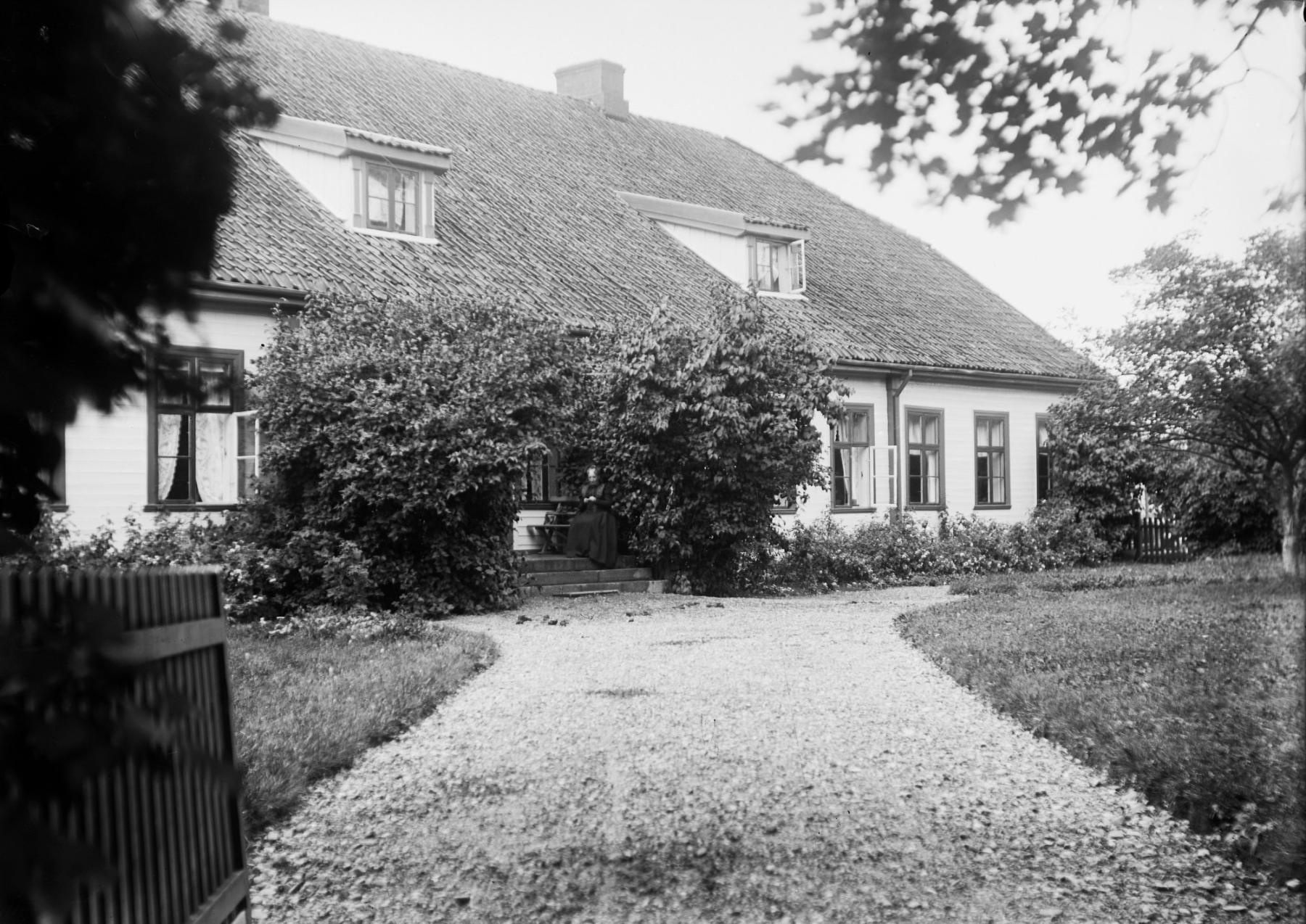
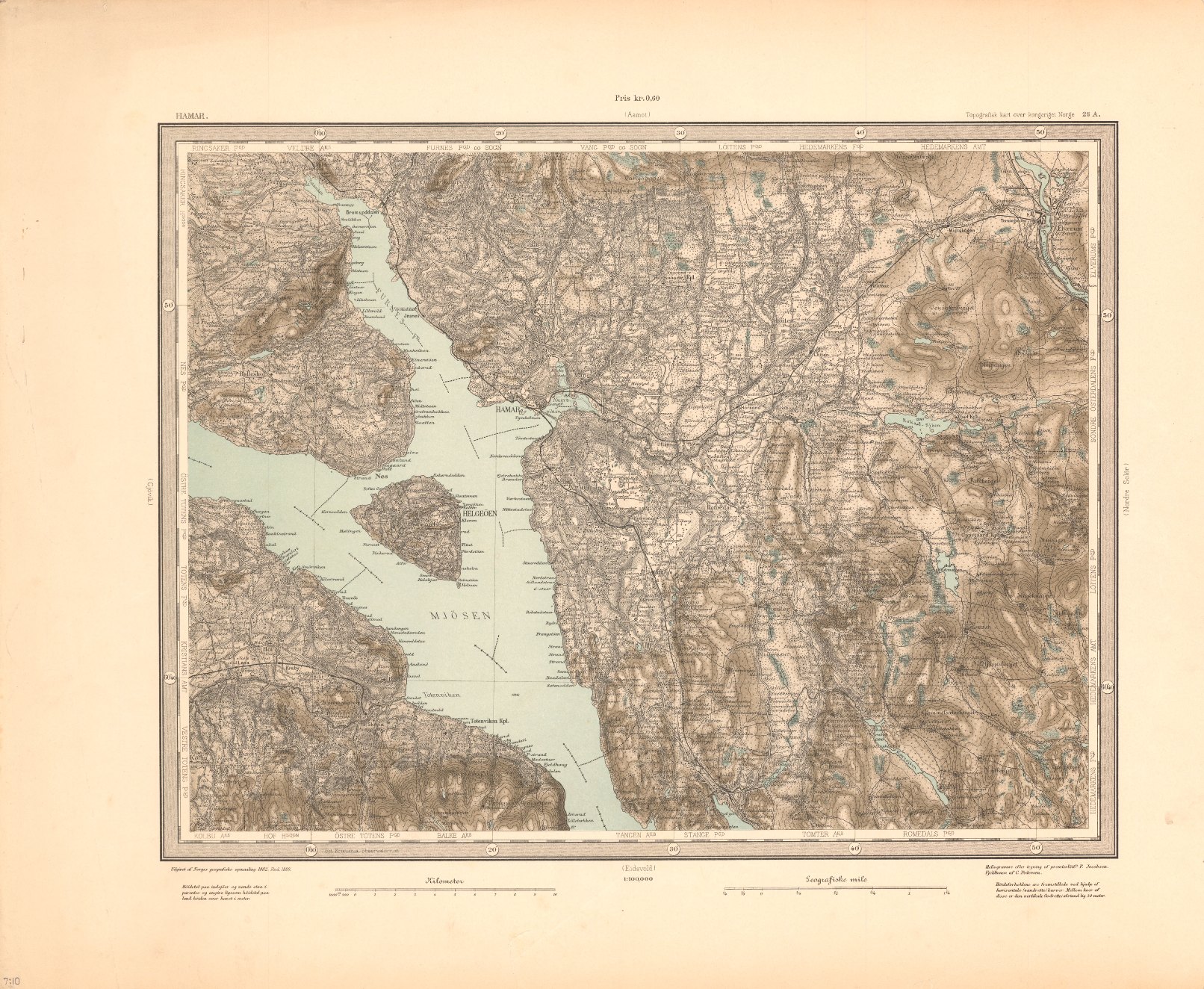
Grefsheim lies on the south-eastern side of Nes, with its fields running down to Lake Mjøsa and views across to Hamar. The main house dates from the 1830s. Around it lie the farmyard, the garden, the old avenues and the buildings added over many generations.
The farm is far older than the house.
The earliest traces of people here go back to prehistoric times. The name appears in written sources from 1313. Since then Grefsheim has been owned by noble families, the Church, the King and private families. People here have farmed the land, worked in the forest, kept animals, run a nursery and raised children. Some left their names in the history books. Far more are known to us only from old photographs, parish registers and stories handed down.
The world beyond Nes has also found its way here from time to time, sometimes in surprising ways.
Long before the first names
At Grefsheim there is a large boulder with 21 small, round hollows carved into its top. They are called cup marks, a form of rock carving particularly associated with the Bronze Age.
The hollows are barely visible from the ground. We do not know for certain what they were used for, but such marks are often linked to the rituals and beliefs of the time.
Other traces survive from the Iron Age. In a burial mound at Grefsheim a decorated bronze brooch, glass beads and a bronze pin were found. From the objects, archaeologists believe this was a woman's grave from the 500s or 600s. The jewellery is now kept in the collections of the Museum of Cultural History in Oslo.
A pair of oval bronze brooches from the Viking Age has also been found at Grefsheim. Brooches like these were used to fasten a woman's dress.
We do not know who the people behind these traces were. Nor do the grave finds tell us what the farm looked like, or whether people lived here continuously through all those centuries.
But they show that people used this landscape long before Grefsheim appears in written sources.
Magnhild and the great Grefsheim estate
Around 1450 Grefsheim belonged to Sigurd, probably of the Skaktavl family. He was married to Magnhild Oddsdatter from Finne in Voss.
Magnhild had already been married once. When Sigurd also died, she married the Swedish knight Alv Knutsson of the Swedish Tre Rosor family.
Together they owned farms and land across much of Norway, including in Western Norway, Romerike, Sunnmøre and as far north as Troms. Grefsheim was one of the farms where the family lived.
Magnhild lived here until her death in 1499.
She managed much of the work on the estates herself. Surviving documents show that she bought and sold farms, settled questions of inheritance and negotiated over property. She carried on doing so after she was widowed for the third time.
Her son Knut Alvsson also lived at Grefsheim. He later inherited much of his parents' property.
Knut was commander of Akershus and in time came into conflict with King Hans and the Danish crown's men in Norway. In 1502 he led a rebellion.
In August that year he met his opponent Henrik Krummedike for negotiations aboard a ship off Akershus. Knut had been promised safe conduct, but was killed during the meeting.
Historians have debated exactly what happened ever since.
The killing had great political significance. Henrik Ibsen later wrote about Knut Alvsson in the poem “På Akershus”, in which the event stands as an image of Norway's loss of independence.
Read more about Knut Alvsson →For the family at Grefsheim the killing had other consequences too. Knut's property was seized by the King. Long inheritance disputes followed before much of the estate came back to the family.
In time it was his sister, Karine Alvsdatter, who held Grefsheim.
Jomfru Karine and the gift the Church nearly received
Karine Alvsdatter, known as Jomfru (Maiden) Karine, owned a number of farms but lived at Grefsheim herself.
In the Middle Ages power was largely reserved for men. But inheritance and property could give some women rare independence, particularly if they were widows or unmarried. At Grefsheim we meet both: Magnhild, who continued to run the estates after she was widowed, and Karine, who never married.
Karine had close ties to the Church in Hamar.
There is an old story about her journeys across Mjøsa. When Karine went to Mass in the cathedral, she was rowed from the Grefsheim jetty. According to tradition she had twelve oarsmen, and the church bells in Hamar did not start ringing until her boat had pushed off.
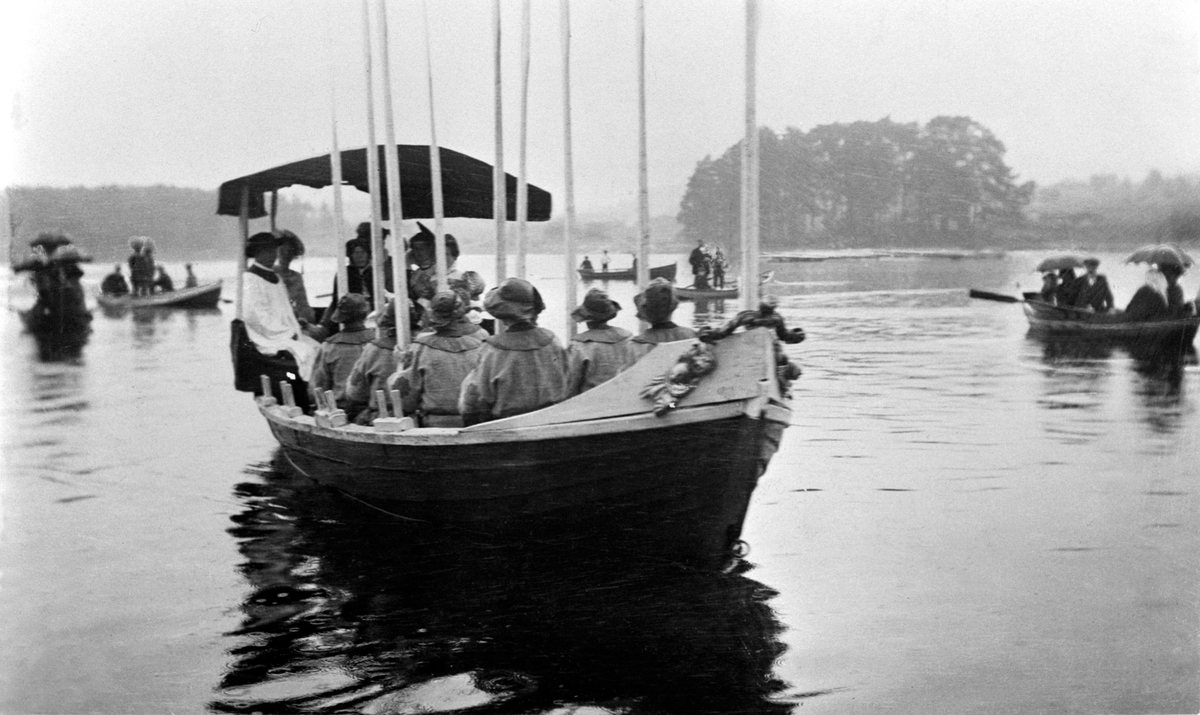
Whether it really happened that way, we do not know. But the story has survived for several hundred years.
Towards the end of her life Karine decided to give Grefsheim and a great many other farms to the Diocese of Hamar and its cathedral. Older historical accounts describe this as one of the largest private gifts the Church had received in Norway.
But the timing could hardly have been worse: the Reformation was on its way to Norway.
The last Catholic bishop of Hamar, Mogens Lauritssøn, took possession of Grefsheim, but as early as June 1537 he had to hand the farm over to Karine's relatives.
So the Church did not keep the great gift for very long.
Grefsheim returned to the family through Gørvel Fadersdotter Sparre, a granddaughter of Knut Alvsson.
Gørvel had been married three times but had no children who outlived her. Her estates were spread across much of Norway, and several relatives laid claim to the inheritance.
She also had to deal with the power struggle between Denmark and Sweden. Many of her relatives were Swedish, while much of her property lay in Norway, under the Danish king.
In time Gørvel found a solution.
She made agreements with the Danish king and gave up her Norwegian estates in return for land, rights and protection in Scania, where she herself lived. In this way she brought more of her wealth closer to home and secured the King's support.
In 1599 she transferred the last of her Norwegian estates to Christian IV.
And so Grefsheim became the King's farm.
The King and his creditors
Grefsheim was in time placed under the Storhamar estate, which brought together many of the Crown's properties around Hamar.
In 1649 the Governor-General, Hannibal Sehested, was granted Storhamar, with Grefsheim and several other farms, as a noble seat.
Sehested fell out with the King. As early as 1651 he had to give the estates back.
Ten years later Grefsheim became a pawn in the King's finances.
The Dano-Norwegian king had large debts.
The brothers Gabriel and Selius Marselis had lent the Crown considerable sums. In 1661 they received, among other things, the former Sehested estate as security for the money.
Grefsheim, too, was thus pledged as security for the King's loans.
In 1675 the farm was sold to Andreas Tombloe and Anne van de Wiele, who lived in Hamburg. After many years under the Crown, Grefsheim was back in private hands.
The owners now had their home far from Nes. We know little about how often they visited the farm, or who was responsible for it day to day.
For those who lived and worked here, life went on. The land had to be farmed, the forest worked, the animals tended and the buildings kept up, whoever's name was on the title deeds.
See all the owners →Fire, new owners and a new house
In 1714 there was a fire at Grefsheim. According to the historical sources, almost all of the farm's buildings were destroyed.
At that time the district judge Hans Blichfeld had lived on the farm. When the fire came, it was his widow who was running it.
The farm was rebuilt.
In 1716 Jens Hansen Grønbech took over. After his death the property passed through his wife Christine Sophie Vagel, her second husband Iver Jentoft and later her nephew Jens Grønbech Wessel.
Christine Sophie was connected with the Storhamar estate for 55 years. In time she became known as “gammelfrua” - the old mistress.
In 1777 Halvor Gundersen Sterud bought Grefsheim for 8,300 riksdaler. He later took the old family name Robarth, which had Scottish roots.
His son Gunder Halvorsen took over the farm in 1802.
He is associated with the planting of part of the long maple avenue from the farm down to Mjøsa. According to the old farm history he got the trees from Jacob Hoel at Hovinsholm.
The avenue is more than 500 metres long and runs east-west, from the farm down to Mjøsa. Grefsheim also has an old avenue along the approach road from north to south, and a shorter chestnut avenue above the main house.
In 1834 Gunder's son-in-law, Lieutenant Norgrenn, took over.
It was under Norgrenn that the present main house was built. Older sources give 1840-1845, while others date the house to the 1830s. The dormers on the roof were added later, in 1902.
So the house itself has a history with several building phases.
The outbuildings have also undergone great changes. There was a fire on the farm in 1902, and in 1914 the farm building burned.
Norgrenn was known as an unusually strong man. He had fought in the war of 1814, and it is said that he could walk on his hands even after turning 80.
He also kept a large and hospitable house, and it came at a cost.
In 1865 Norgrenn went bankrupt, and Grefsheim was sold at auction. The buyer, the merchant Henriksen, died shortly afterwards. Two years later the farm was sold again.
This time to the district judge Johan Henrik Egeberg.
A farm as a confirmation present
Johan Henrik Egeberg bought Grefsheim in the spring of 1867. He and his wife Johanne Henriette Meyer otherwise lived in Kristiania, but began spending their summers on the farm in 1869.
Egeberg was keen to improve the property. Day to day, he left the running of the farm to others.
The couple had no children, but Egeberg had a godson and great-nephew, Johan Egeberg Mellbye, whom he wanted to take over.
Johan was given Grefsheim as a confirmation present in 1883. When he took over the running of the farm in 1889, he was 23 years old and a trained agronomist.
Johan was interested in new farming methods, better animal husbandry and more modern agriculture. He developed the farming at Grefsheim, while becoming more and more involved in agricultural politics.
In 1896 he was one of the founders of Norsk Landmandsforbund, which later became the Norwegian Farmers' Union. He led the union for many years and was both a government minister and a member of the Storting.
But at home at Grefsheim there was still a large farm to run.
Photographs from this period show a working life full of people. Hay-drying racks in the fields, horses in front of the implements, workers in the farmyard and work in the cowshed.
Much had to be done by hand. There were far more people at work than on a farm of a similar size today.
The family also had many guests.
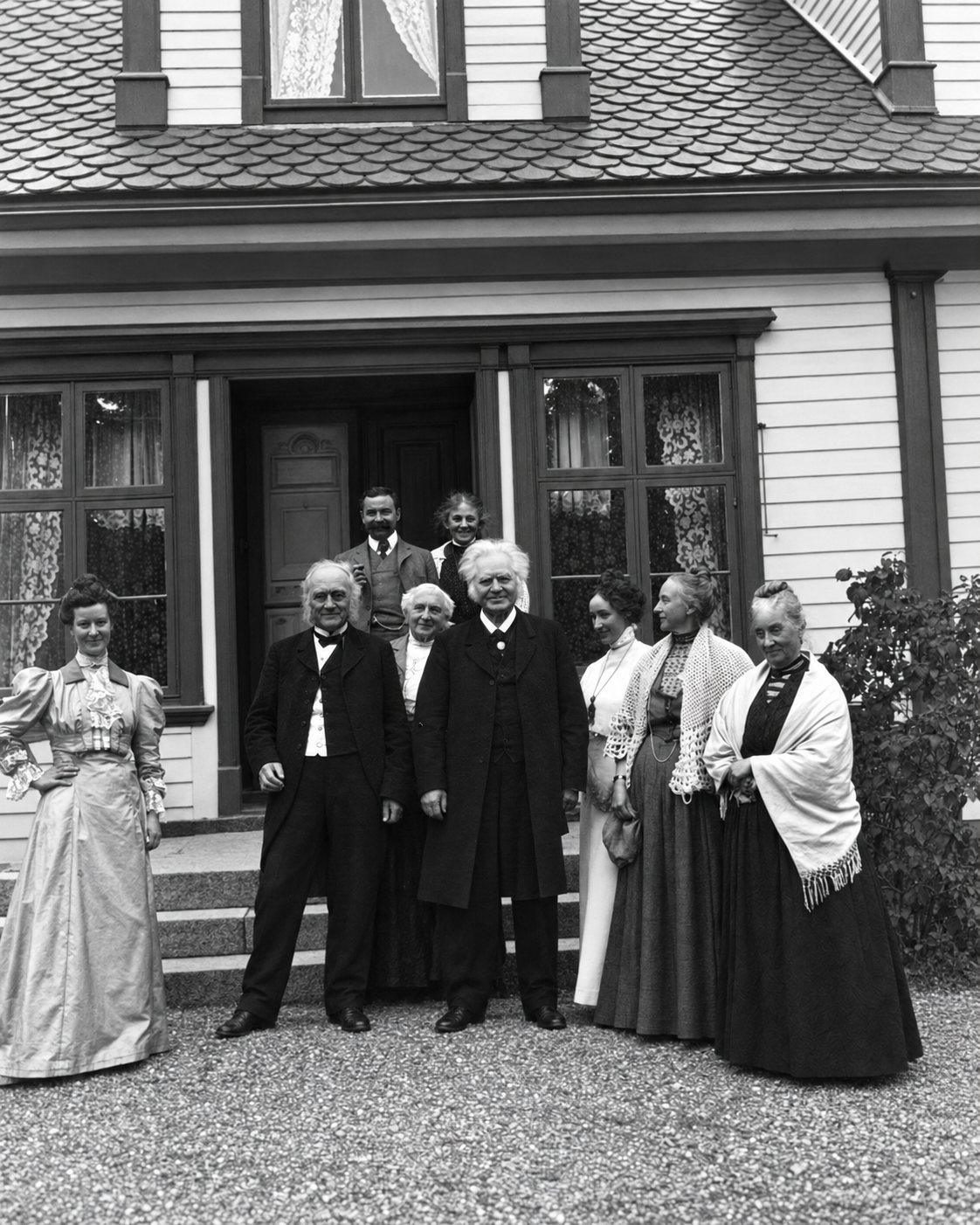
In 1907 Bjørnstjerne Bjørnson visited Grefsheim with his wife Karoline. The visit is preserved in old photographs.
Among the drawings from the farm are also works by Carl Frederik Diriks, better known as Fyrdiriks. He was director of lighthouses, but also a skilled and humorous draughtsman. One of his drawings from 1886 shows the cowshed being washed at Grefsheim.
See the drawings by Fyrdiriks →The people who kept the farm going
Many of Grefsheim's owners are known by name. We know far less about those who worked on the farm, although there were many more of them.
Over time, more than 30 crofts, shore crofts and other dwellings belonged to Grefsheim. There were also workers' cottages, a stockman's house and a separate hostel for employees.
In 1865, 207 people lived at Grefsheim and on its crofts, in 33 households.
The crofts were home to families who had a small plot of land for their own use, but who often also had a duty to work on the main farm. Some paid rent in money or goods, others in labour.
Down by Mjøsa lived shore crofters, who could make a living from fishing, crafts and other work.
The farm needed people for the fields, the animals, the forest and the houses. Later came the gardeners and the workers at the nursery.
Ødegården, Sveen, Sannerud, Snippsand, Hukibak and Kampenhøi are among the old croft names that still survive.
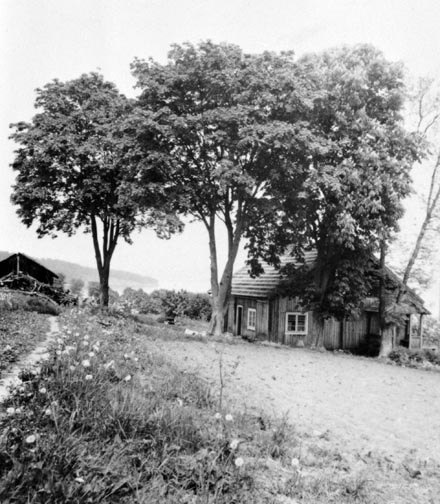
The differences between those who owned the land and those who worked it were great. Many crofting families were tied to the farm for several generations. They had their own homes and families, but at the same time depended on the work and the terms set by the main farm.
Some stayed in Nes. Others moved on, some of them across the Atlantic.
Every year visitors come to Grefsheim from the United States. They are looking for the places where their ancestors lived and worked, often after spending a long time tracing the family back through parish registers and other old documents.
Several generations may have passed since the family left Norway. Even so, the descendants want to see the farm, the houses and the landscape they have heard about.
Several of the old crofts have been preserved and restored. Some of the houses are still in use, while other crofts can only be found on old maps or through names that have lived on.
We know the stories of the people on the crofts only in part. Sometimes new information comes to light, through a photograph, a letter or a family that has kept what it knows.
A young Austrian on a summer visit
For many years Grefsheim had visits from family and friends. Some came back summer after summer.
In the summer of 1920 a 21-year-old Austrian came to the farm. His name was Friedrich Hayek, and he had been ill with malaria.
He arrived at Grefsheim on 27 July and stayed until September.
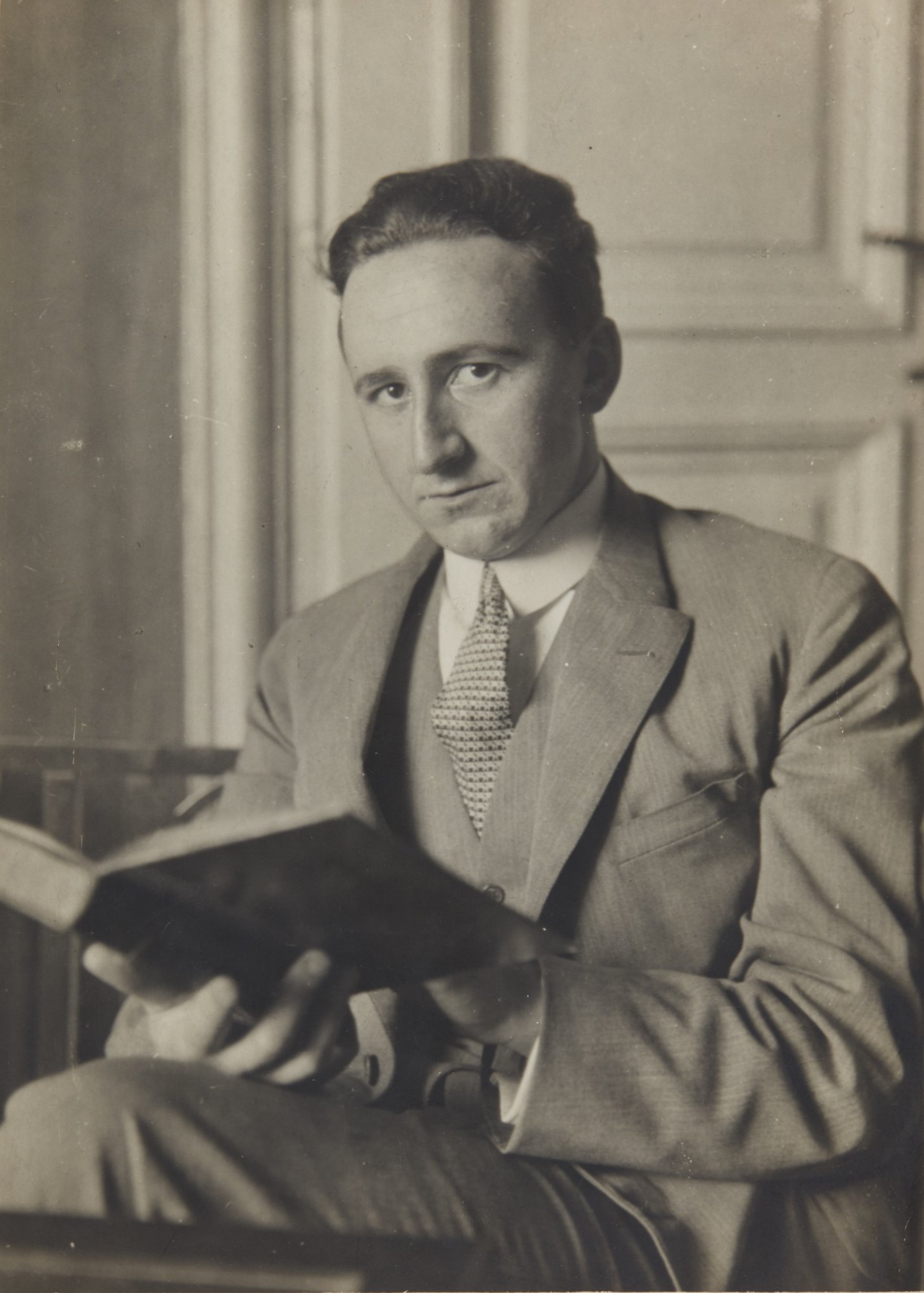
Hayek kept a diary during his stay. It tells of tennis, swimming, riding, boat trips and long days of reading. He tried to learn Norwegian and worked on his own notes and a manuscript.
One day in August he described how the day had gone: tennis in the morning, breakfast, study, swimming, lunch, a little Norwegian lesson, coffee, work on his own notes and, as often as not, another round of tennis before dinner.
He also read Adam Smith.
Hayek returned to Austria and continued his studies. He later became a professor of economics, and in 1974 he was awarded the Nobel Prize in Economics.
At Grefsheim he was still a young student spending the summer with the Mellbye family, partly to recover from his illness.
More small stories →The nursery that began with a few extra apple trees
In the same year that Hayek visited Grefsheim, Johan Egeberg Mellbye was busy planting an orchard.
A Swedish gardener helped him graft apple and plum trees. In the autumn of 1920 a batch of apple rootstocks also arrived from Holstein in Germany.
More trees were produced than the farm itself needed.
The extra trees were sold. That was how Grefsheim Nursery began.
The first nursery catalogue appeared in 1923. At first fruit trees and berry bushes dominated. Later came roses and other garden plants, and as early as 1924 the nursery could offer its first rose varieties.
The business grew, and the planting fields spread down towards Mjøsa. The roses in particular left their mark on the landscape, and from Hamar the colourful fields could be seen on the other side of the lake.
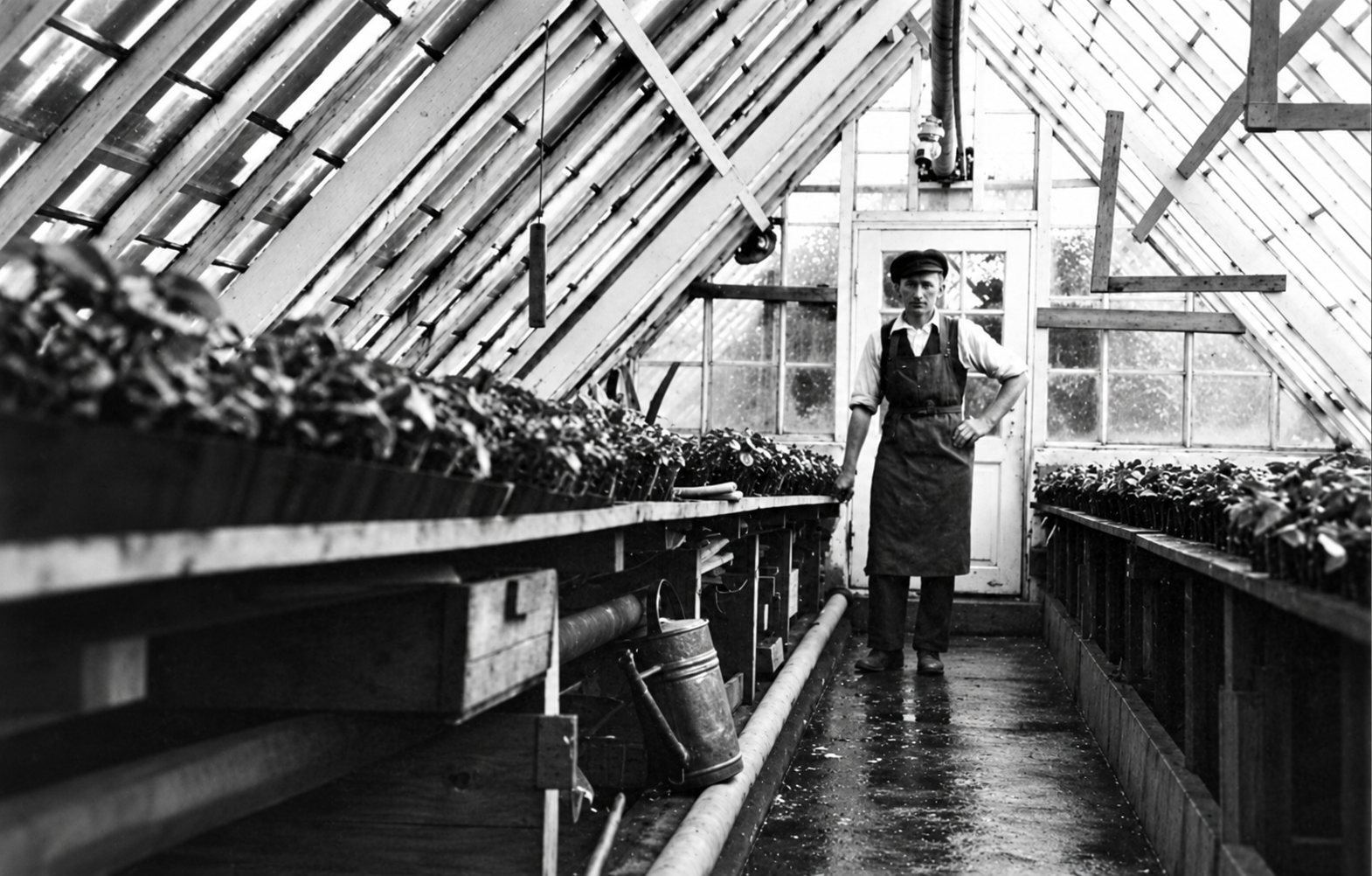
The nursery gained customers across much of the country and became an important workplace at Grefsheim.
In 1949 the nursery manager O. Imsgard made a discovery while clearing an old planting field.
He found a spiraea that stood out from the others, and kept it.
The shrub had long, arching branches that in spring were covered in small white flowers. It was later named Spiraea × cinerea ‘Grefsheim’. It had previously been known as Spiraea × arguta ‘Grefsheim’, before botanical studies led to a different classification.
The plant was propagated and sold by nurseries in Norway and abroad. It is still found in gardens across much of Europe, and is sold elsewhere in the world too.
Perhaps not many people stop to think where the name comes from when they buy a Grefsheim spiraea. But the shrub flowering in their gardens has its origins in an old planting field in Nes.
A rose was also named after the family: ‘Emelie’, after Johan Mellbye's wife.
In 1953 his sons Jan and Lennart Mellbye took over the nursery. Lennart was particularly interested in roses and later wrote books about rose varieties suited to Norwegian conditions.
In time the nursery was separated from the main farm and continued at Haug. In 1980 it was named Mellbyes Planteskole.
The business is still run by the family, now concentrating on producing trees for parks and landscaping.
It all began with a few apple trees too many.
The farm through new generations
While the nursery grew, work on the main farm carried on.
Johan Egeberg Mellbye's son Jan became farm manager in 1938 and took over Grefsheim from his father in 1947.
Jan, too, became involved in agricultural politics and later led the Norwegian Farmers' Union.
This was a time when Norwegian agriculture was changing fast. Tractors and other machines took over much of the work that had once required large teams. The number of workers on the farms fell, and farming became more and more mechanised.
At Grefsheim, much of the working life that had shaped the farm for several hundred years gradually disappeared.
The crofting system was already history. The nursery developed into a business of its own, and the main farm continued with arable farming, livestock and forestry.
From the late 1970s it was the next generation, Johan Edvard Mellbye and his wife Anne Lise, who carried the farm forward.
They took over a farm where much had changed, but where several of the old houses, the avenues and the traditions were still part of everyday life.
Like earlier generations, they also had family and guests to stay.
But one summer they were to receive guests for quite a different reason.
When the peace negotiations came to Grefsheim
On Saturday 3 July 1993 a group of guests arrived at Grefsheim in strict secrecy.
They represented Israel and the Palestine Liberation Organization, the PLO.
For several months Israeli and Palestinian representatives had been meeting in Norway through the so-called Oslo channel. The official peace talks had stalled, but through secret meetings Norwegian facilitators were trying to help the parties reach an agreement.
Now one of the rounds of negotiations was to take place at Grefsheim.
Johan Edvard and Anne Lise Mellbye were the hosts. They had been told to prepare for a group of guests, but only learned late who would be coming.
The Palestinians were accommodated in the main house, while the Israelis stayed in another house on the farm.
The negotiations took place in the drawing room, among other places, and went on late into the evenings.
The parties worked on a draft declaration of principles. The disagreements were considerable. The Israeli draft that was put forward met with strong objections from the Palestinians, who felt it went back on what had earlier come close to agreement.
There was nothing like a finished agreement when the delegations left Grefsheim.
But the talks continued. Through the summer the parties met several more times in Norway, and in August they reached agreement on a declaration of principles.
On 13 September 1993 the Oslo Accord was signed publicly in Washington, with Yitzhak Rabin and Yasser Arafat present.
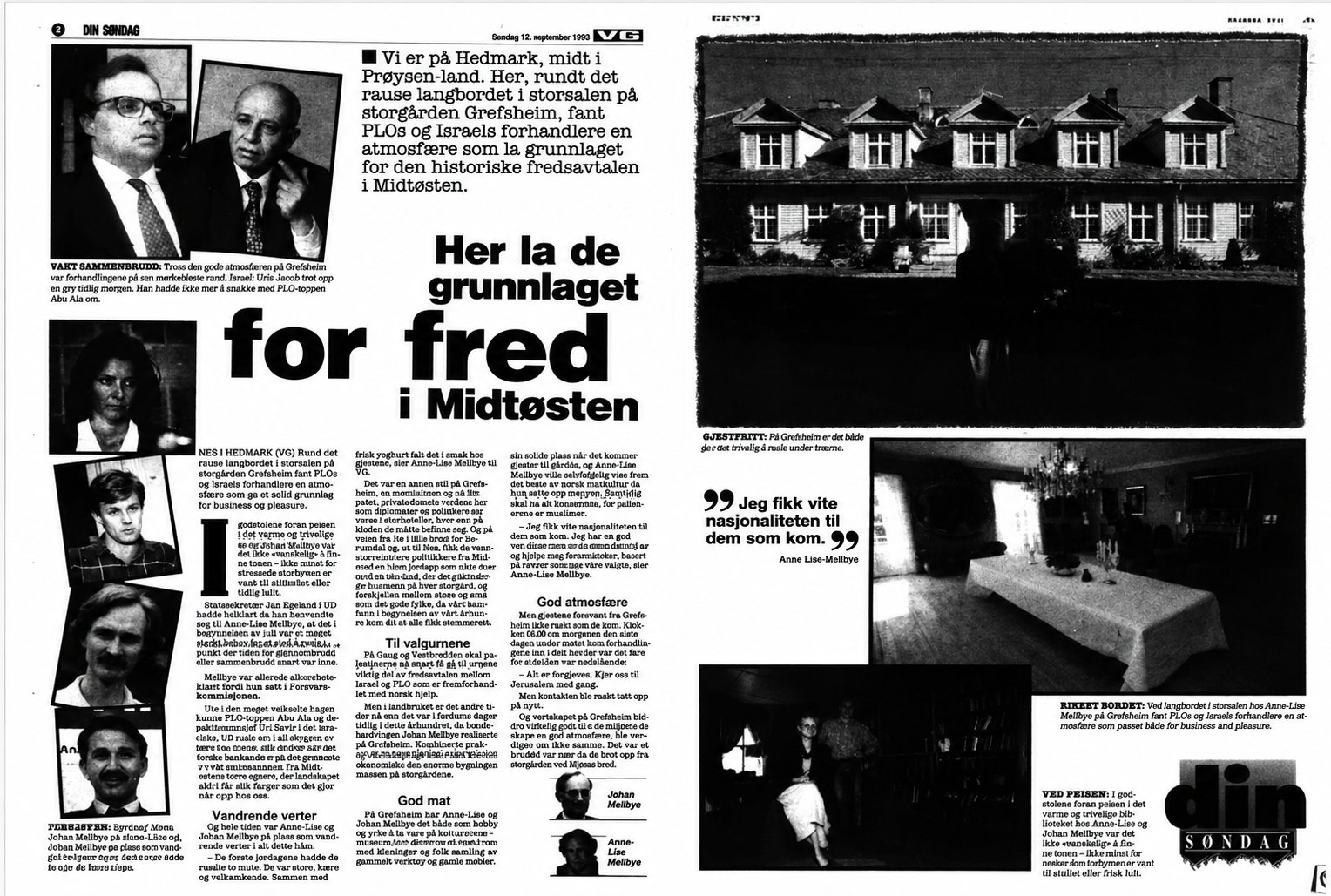
The agreement raised great hopes. It was meant to open the way to peace between Israelis and Palestinians, but a lasting solution never came.
At Grefsheim, meanwhile, international politics had some rather everyday aspects.
According to the family's account, Johan Edvard felt that the many security men in dark suits were attracting rather too much attention. Some of them were therefore set to mowing the lawn and trimming the hedge.
On another occasion the cows got out of their enclosure. Both Israeli and Palestinian negotiators were keen to help bring them back in.
The bodyguards were less enthusiastic about the idea.
Read more about the Oslo negotiations in 1993 →Grefsheim today
Grefsheim has changed a great deal over the last few generations.
The work that once required many people is now largely done by machine. Several of the old buildings have found new uses, and the farming has changed.
Milk production ended in 2011, when the farm switched to suckler cows and beef production.
Today Grefsheim is farmed for grain and forestry. The production of potatoes and onions has ended, and catch crops are part of the grain farming.
The farm has been taken over by Anette Mellbye and her husband Dagfinn Møller, who carry it on as a working farm and a home.
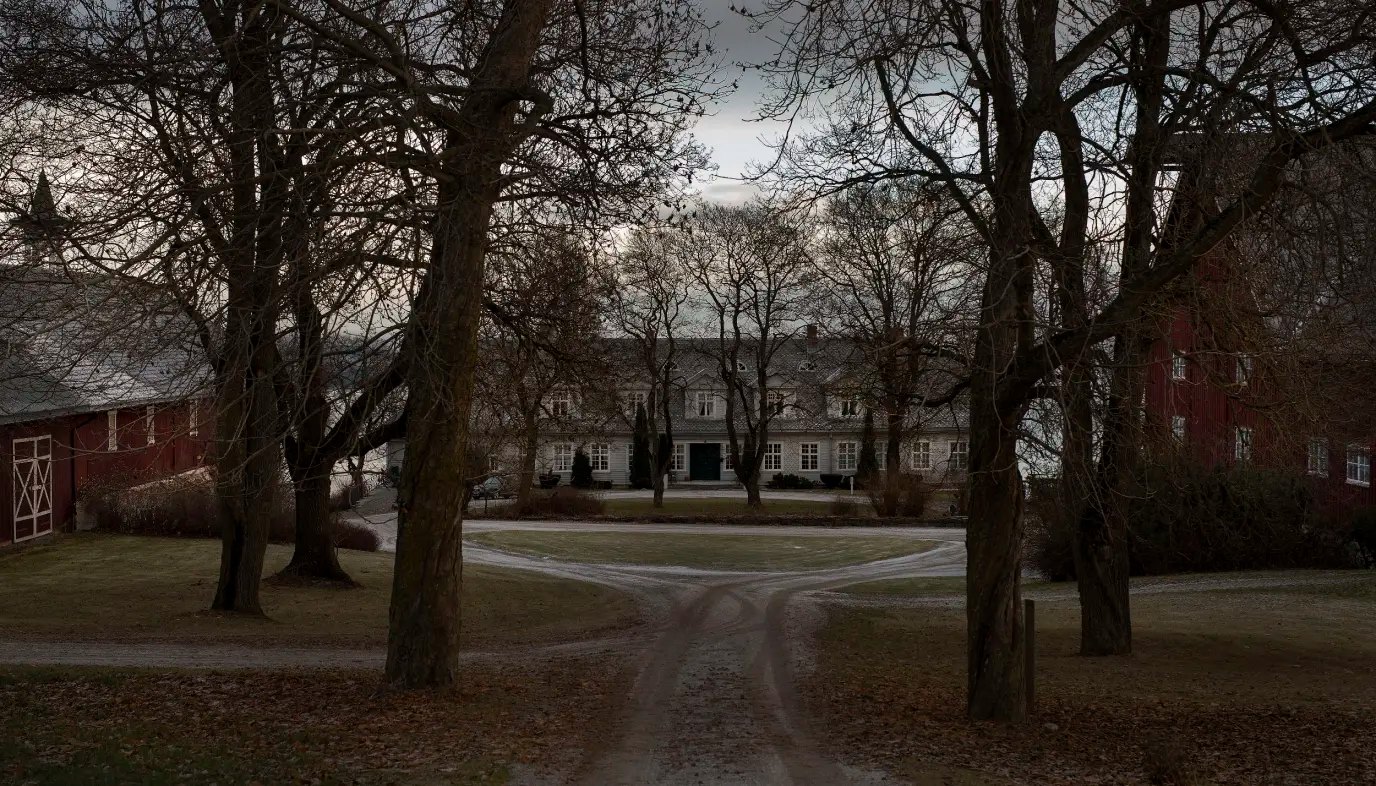
The old avenues still stand. The main house is still the one built in the 1800s, although it has been through many changes since.
Several of the crofts have been restored and brought back into use. Others survive as traces in the landscape, on old maps or in names still in use.
Photographs, letters, paintings and documents from earlier generations are kept on the farm. Some of this has long been known. Other things come to light when old albums are opened, or when someone gets in touch with a picture or a story their family has kept.
About some of those who lived here we know a great deal. About others we know almost nothing, and the work on the farm's history is not finished.
See photographs and documents in the archive →Sources and further reading
The history of Grefsheim is based on historical publications, archaeological investigations, public registers and material kept on the farm.
The farm's history
- Wladimir Moe: Norske Storgaarder. Second, expanded edition (1920).
- Axel Coldevin: Norske storgårder, volume 1 (1950).
- Gunhild Kolstad: Nes bygdebok - Bruks- og slektshistorie, Østfjerdingen, vol. 2, part 2 (1995), pp. 345-426.
- Store norske leksikon (Norwegian encyclopaedia): Grefsheim
Archaeology and cultural heritage
- Museum of Cultural History / DigitaltMuseum: Bronze brooches from Grefsheim (C1114)
- Ingunn Marit Røstad: The Language of Jewellery (2021), including the grave find C22394.
- Directorate for Cultural Heritage: Kulturminnesøk - registered heritage sites, including the cup-mark stone.
Farm life and the nursery
- Ringsaker Municipality: Heritage plan (2018), especially page 34.
- Mellbyes Planteskole: About us
- Norske utvalg og foredlinger av busker og trær (2006), on the origin of the spiraea ‘Grefsheim’.
Historic visits and the peace negotiations
- Bruce Caldwell and Hansjoerg Klausinger: Hayek: A Life, 1899-1950 (2022).
- Store norske leksikon (Norwegian encyclopaedia): The Oslo channel
- Hilde Henriksen Waage: Peacemaking Is a Risky Business (PRIO, 2004).
Grefsheim's own archive
Photographs, letters, paintings, documents and family stories passed down by word of mouth. Some anecdotes are based on information preserved within the family, which is not necessarily found in public archives.