Harvest at Grefsheim
– as I remember it
By Tore Mellbye · Written in 2023
Tore Mellbye grew up at Grefsheim. Here he writes about the grain harvest, about the farm workers and about how farming changed while he was growing up.
an E and Tora Mellbye's third child, I grew up at Grefsheim. I was born in 1950, and my «conscious» life began at about five. I took part in life on the farm for some 16 years, before leaving home in 1971.
What makes these years especially interesting is that farming in general, and at Grefsheim in particular, went through major changes – rapid development, with mechanisation but also continual rationalisation. This led to falling populations in the countryside and the end of the traditional farm labourer on the larger farms.
Here I will concentrate on my experiences of the harvest at Grefsheim from about 1955 to 1971, with the reservation that some dates may not be quite right. I have written this mainly for the family, some friends and those I grew up with at Grefsheim, which was then a small «community». In my class at primary school five of us «belonged to» the farm. I have tried to write in plain language, with some explanations for people who do not know the words and expressions of farming.
To tie the story together I start with some definitions and background, including the harvest before my time.
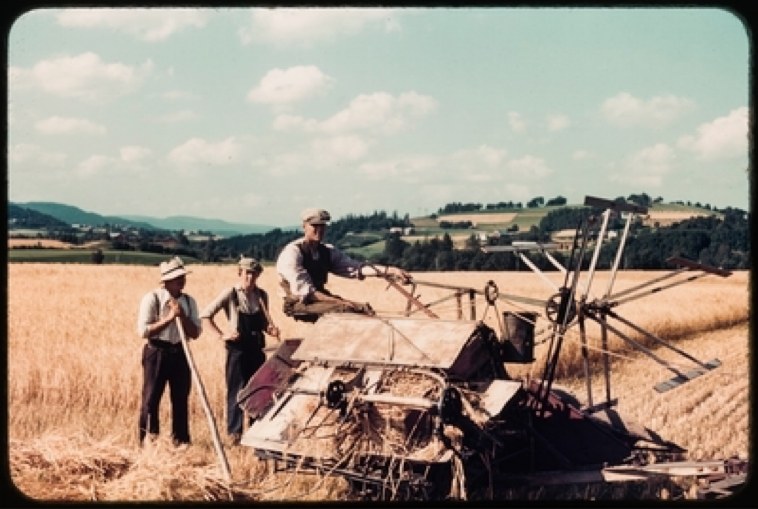
Skuronn – the grain harvest
Skuronna is the name for the work of harvesting and processing grain, from sowing to finished delivery of grain for milling into flour, animal feed and seed for the next season (foundation seed). The name comes from an old word for cutting, «skur», and the Old Norse word «onn» – the yearly work of farming, as in spring work, haymaking and potato lifting.
The harvest before my time
Until the 1800s grain was cut with a sickle. The cut grain, called loa, was «bundled» into sheaves with a band of straw.
In the 1800s the sickle was replaced by the scythe, often fitted with a cradle to lay the straws more evenly.
McCormick patented his horse-drawn reaper in 1834. Binders that tied the sheaves with twine came around 1880. In time these came to Norway too. My grandfather, Johan Egeberg Mellbye, was greatly inspired after seeing binders at work on visits to Scotland in the 1890s. So Grefsheim was probably fairly early with a binder, around 1900–1910. A steam engine was bought as well to drive the first threshing machine. This was a mechanical revolution.
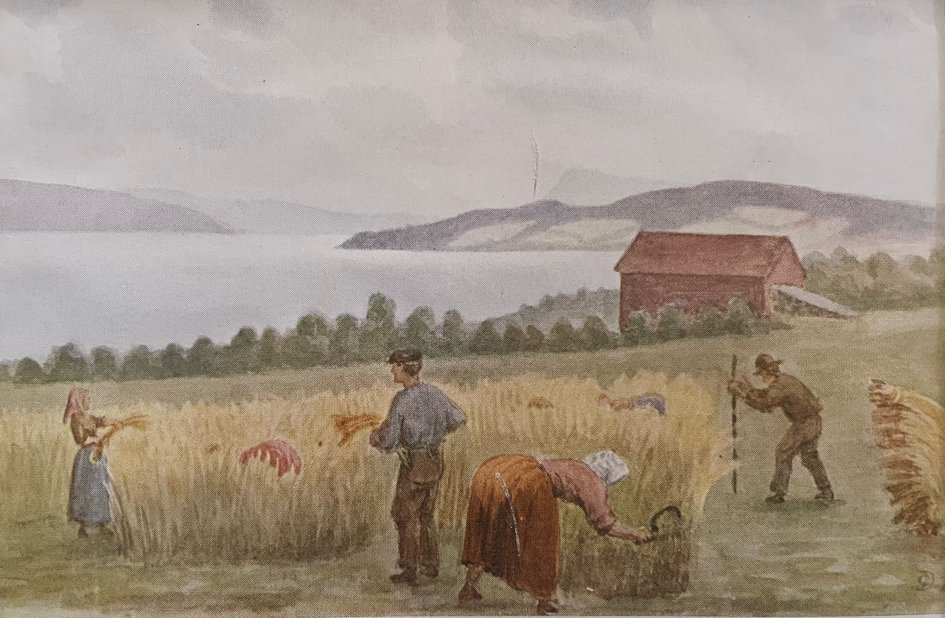
The binder
A machine for cutting, gathering and tying grain into sheaves. The binder came from the USA around the turn of the last century, to Grefsheim as well. At first it was pulled by two horses, later replaced by a tractor in the 1930s–40s. One man led the horses by the reins, and one man minded the cutting table and the binding mechanism. The grain was cut as with a mower and helped onto the table by a reel (a rotating mechanism at the front – see the picture below). It was then carried up to the complicated gathering and binding mechanism, which gathered it, wrapped binder twine round and tied it into sheaves. Binder twine was a strong cord of sisal, a fibre from an agave plant. The sheaves landed on the ground, where they were gathered for further drying.
The binder was used at Grefsheim until the second half of the 1950s. It did not thresh; threshing had to be done afterwards with a threshing machine.
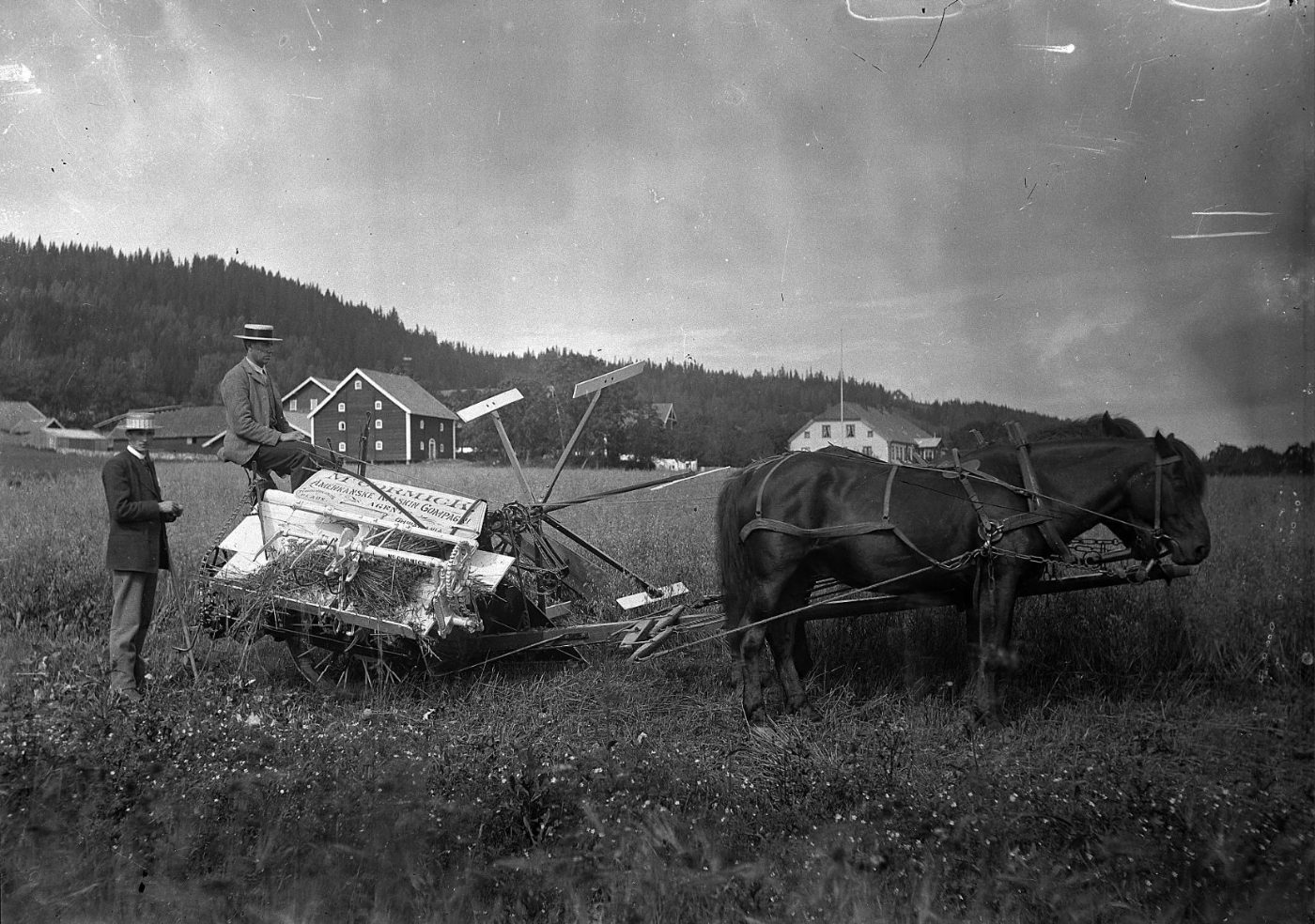
Sneis – drying racks
A way of drying sheaves in the field before carting and threshing. 8–10 sheaves were threaded onto a stake, the first standing upright and the rest laid horizontally on top.
Lo
Cut, unthreshed grain, usually in sheaves, set on stakes to dry. When the grain was dry it was carted to the barn and stored for later threshing.
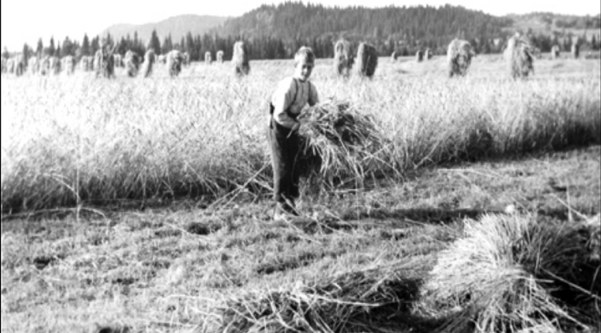
Threshing
The process of separating grain from the ear – «separating the wheat from the chaff». At first threshing was done on the ground or a wooden floor with a flail, also called a beating stick: a long handle with a short, broad piece of wood tied to the end. You «beat away» at sheaves on the floor and so separated grain and ears. In time the flail was replaced by simple, mostly hand-driven threshing machines.
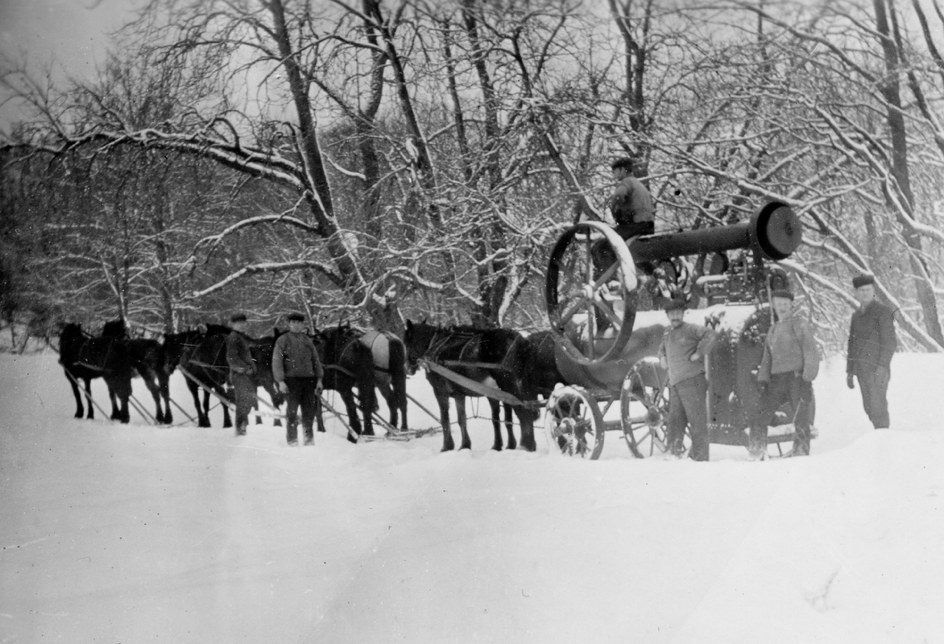
From the mid-1850s the more advanced, engine-driven threshers came to Norway too. Huge machines like steam locomotives transferred power via pulleys and balata belts to mobile and stationary threshers. Later the big steam engines were replaced by petrol or paraffin tractors and then by powerful electric motors.
How a threshing machine works
Cut-open sheaves were thrown into the drum at the top of the machine. The drum consisted of a half-cylindrical «bridge» with metal bars, where a fast-spinning beater knocked the fine parts (grain and stubble) through the bars. The straw was thrown backwards, while the fine parts were shaken over several sieves with holes matched to the grain size.
The grain fell through, while awns, straw bits and chaff were blown back and out by a larger fan. A conveyor carried the grain to the front of the machine, where it was «bagged up» in large jute sacks.
The threshing barn
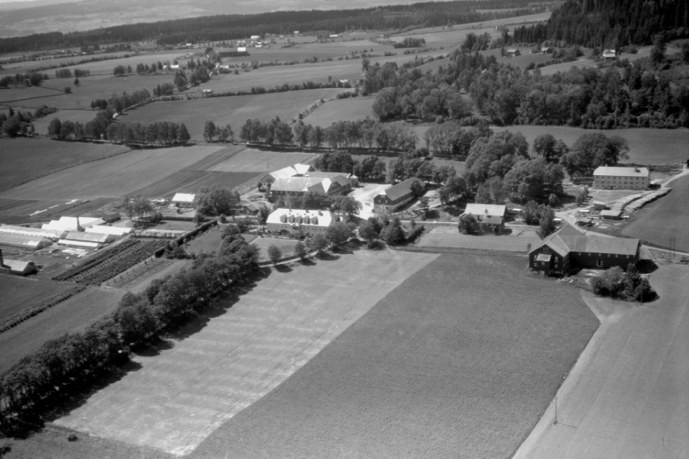
A large barn north of the farm, level with the farmhouse, beyond the farmhands' house and below the hostel.
Main axis west–east with a gable to the north. A barn bridge on the upper side led up to the barn driveway (the track inside the barn where the loads were driven in), which ran the full length of the barn and out along the northern axis.
Two storeys in the upper part, three in the lower part with a drive-through (south–north) where the threshing machine stood. The top floor was the threshing floor (an inner barn bridge), where the grain was driven in and «tipped down» to the floor below for further drying and storage, and later «fed» into the thresher. I always found it frightening up on that floor – a long way to fall, up to 4–5 metres! It can hardly have been easy to turn a horse and cart up there either!
At the top of the barn, at the north end of the threshing floor, various fertiliser sacks were kept, from compound fertiliser to potash and lime. The fertiliser was often hard and lumpy and was broken up with a huge wooden mallet. It then went into a large floor-mounted roller mill and down into a trailer on the floor below, to be taken out to the field and spread with the fertiliser spreader. The spreader was a big thing pulled by a tractor, with a transverse box (turned lengthways for road transport), where rotating discs and a small propeller distributed the fertiliser on the ground.
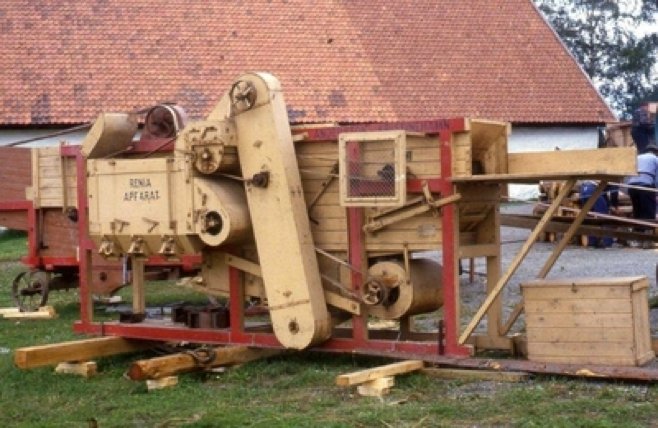
The threshing machine was big, of the Nordsten type, and stood in the south–north passage in the lower third of the barn. It was driven by balata belts: cotton cloth woven in several layers, in great widths and lengths, then impregnated with a kind of rubber called balata. The belts ran round two pulleys, one fixed to an electric motor, and transferred power to a pulley on the thresher.
At the bottom front of the machine the grain was «bagged up», closed and tied with binder twine before being carried up a floor. There the sacks were stored until collection. According to my father, Jan E.M., these jute sacks could weigh well over 80 kg and were carried on the back – «where was the safety officer?», you might ask. I remember some of the sacks had exciting, «exotic» labels such as «Cafe do Brazil».
On the second floor a man cut the sheaves and threw the grain into the thresher, where it «met its fate» in the fast-spinning drum. The drum separated grain from ear, before further cleaning sorted straw, chaff, awns and grain over various sieves. We had great respect for that area and were warned not to go too near the drum. The machine and motor made a terrible noise, though I cannot remember any talk of ear protection! I know of no one ever being injured in the thresher, though.
The most unpleasant job was standing behind the thresher (to the north), where the straw came out with a cloud of chaff, dust and awns. According to my father, Jan, this unenviable job was called «standing in the hen's backside» of the machine. I have heard the expression was used in Snertingdal too. There was surely a great risk of developing the condition known as «farmer's lung».
In later years the straw went into a baler that made bales for alkali treatment and use as cattle feed. The treatment broke down the cellulose in the straw and so increased its feed value.
As far as I remember, steel wire was used at first to tie the bales. This was later replaced by binder twine, since bits of wire could end up in the cows' feed and cause the dreaded condition «kvasst»: sharp bits of metal ending up in the cow's second stomach, the reticulum, where they could bore their way through the stomach wall and injure the cow, sometimes fatally. In my time the only remedy was a rather risky operation. Later the cow was made to swallow a plastic-coated bar magnet that stays in the reticulum and catches metal bits. When the cow was slaughtered, the magnet was passed on to the next young animal.
I can remember the binder in use, the carting of grain and threshing in the threshing barn, so I assume the combine harvester did not arrive on the farm until the end of the 1950s.
The trailed combine
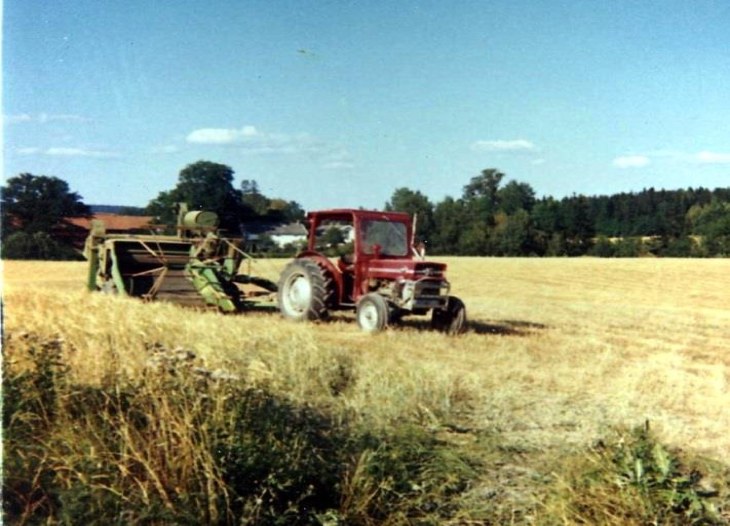
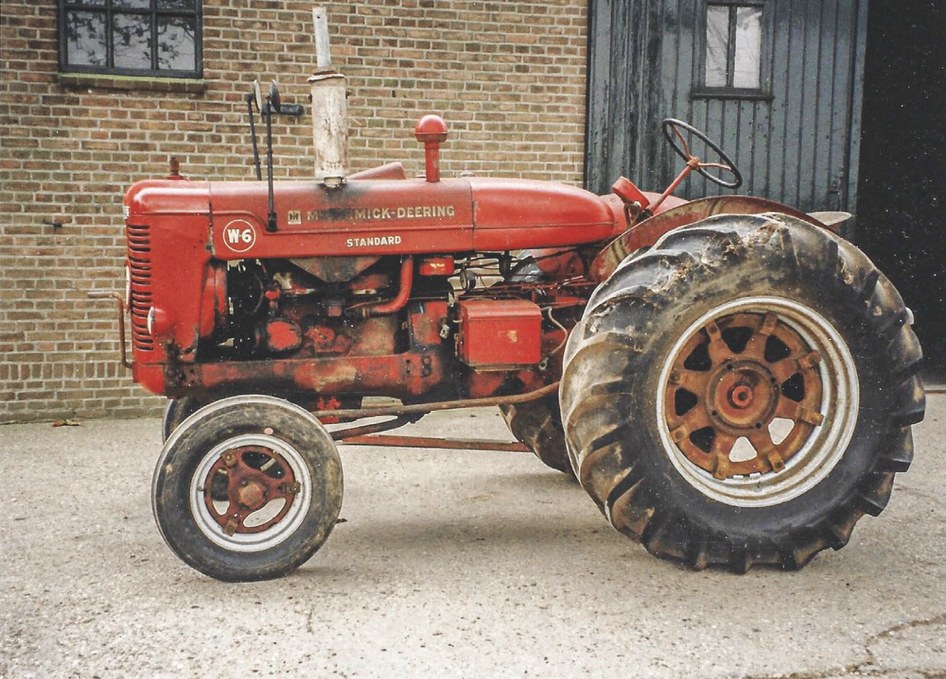
The first trailed combine, of the Swedish make «Aktiv», came to the farm at the end of the 1950s and simplified the harvest a great deal. The principle was the same, with knife, cutting table and reel feeding a mounted thresher, pulled by a tractor and driven by its power take-off. The first trailed combines were pulled by an enormous «beast» of a tractor: the McCormick Deering (started on a small petrol engine, and when warm it ran on paraffin), later by the more modern Fordson Major.
The tractor driver steered the tractor along the field for the combine's cutting table and raised and lowered the table. One man filled the sacks, which after bagging and tying were laid on a sloping board and dropped in «rows» in one place in the field. From there the sacks were «picked» up, loaded on a trailer and taken to the barn. These were «rows» of up to 20–30 sacks.
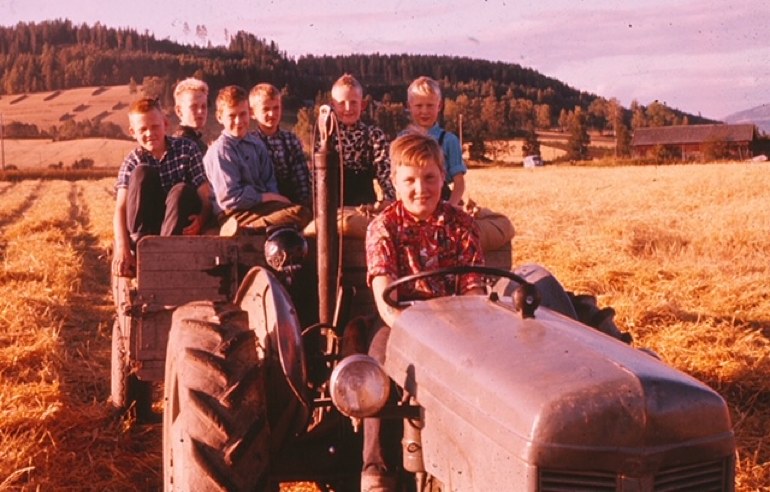
We young lads on the farm thought it great fun to bring in sacks with tractor and trailer. The biggest of us got the «star» job: driving the tractor, preferably the «petrol Ferguson», a so-called «Grey Fergie». The others lifted sacks (four boys to a sack) and stacked them on the trailer – later carried into the barn.
The grain
The first trailed combines were sensitive to damp grain. You often had to stop to clear the elevators of jammed grain. If the grain was damp, the sacks were spaced apart to dry further and to prevent heating and mould. Grain keeps when its moisture content is below 14%. When it rose towards 20%, harvesting and storing without damage became difficult. Moisture was measured by weighing a certain amount of grain, drying it in a special pan on the stove (a lovely smell in the kitchen!), weighing it again and finding the moisture percentage in a table. Later this was done with an instrument that measured the grain's electrical conductivity.
Grain from Grefsheim was usually delivered as «foundation seed» for the next year's seed grain to Strand Brenneri. This made special demands on purity, grain quality and handling. It was especially important to keep wild oats out of the fields. The price for foundation seed was somewhat better than for ordinary feed grain.
Fields to be sown need good cultivation, to create a seedbed and control weeds and fungi. They are usually ploughed in autumn, and in spring levelled and harrowed before large stones are removed. Today sowing is done with a combination drill, whose coulters both sow the grain and add the right amount of fertiliser. Finally the field is rolled. Well after germination it is sprayed against fungal and mite diseases. It is also sprayed with a growth regulator that shortens the stems and so reduces the risk of lodging.
Grain varieties have changed over time. In the 1950s it was mostly two- and six-row barley, the latter with a slightly shorter growing season, as well as oats and some rye. The varieties then grew more slowly and yields were much smaller than now. The average was probably around 250 kg per decare. There were no growth regulators. Heavy rain and strong wind often caused lodging, made worse if you had fertilised a little too generously. Early lodging and a wet autumn with a late harvest could lead to sprouting, which made harvesting difficult and reduced both quality and quantity. Harvest seldom began before late August or early September. Cold and rain could cause long delays and sharply reduced yields and quality. I remember one year when snow had fallen on the last field to be harvested.
Over the years wheat has come in – spring wheat and partly winter wheat (sown in autumn). The growing season used to be a little too long, but new varieties have shortened it and given much larger yields. In «bumper years» wheat yields can exceed 700–800 kilos per decare. Much of the grain grown in Norway is still two-row barley, but in the lowlands and southern Norway wheat has taken more and more ground, and rye has made a comeback. In recent years «hybrid» wheat and rye have also arrived.
The season
The harvest was a special time – surely tied to great expectations and a particular «season» feeling among farmer and farm workers alike. People worked intensely, often late into the evening and at weekends too, but never during «church time»! I remember it was a treat to be on the combine. In time I learned to tie the sacks from strong, steady Kristian Sveen. It was no good if a sack «came undone» after landing on the ground!
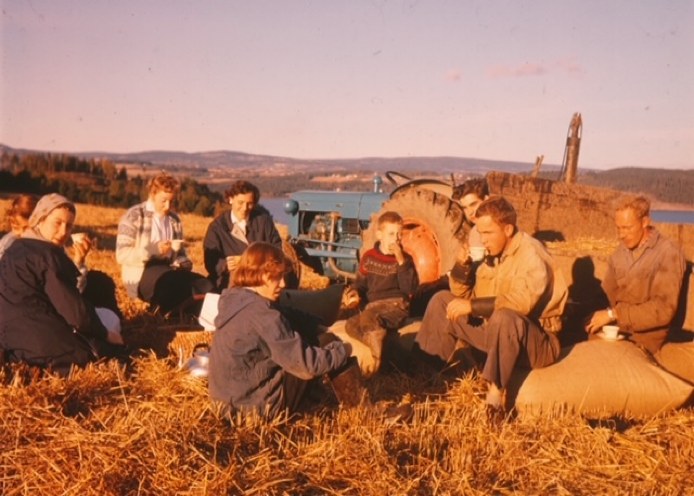
When the work was at its most intense, often into the evening, mother sometimes came down to the field with coffee, squash and buns. Then it was grand to be one of «the men»!
Self-propelled combine / grain dryer
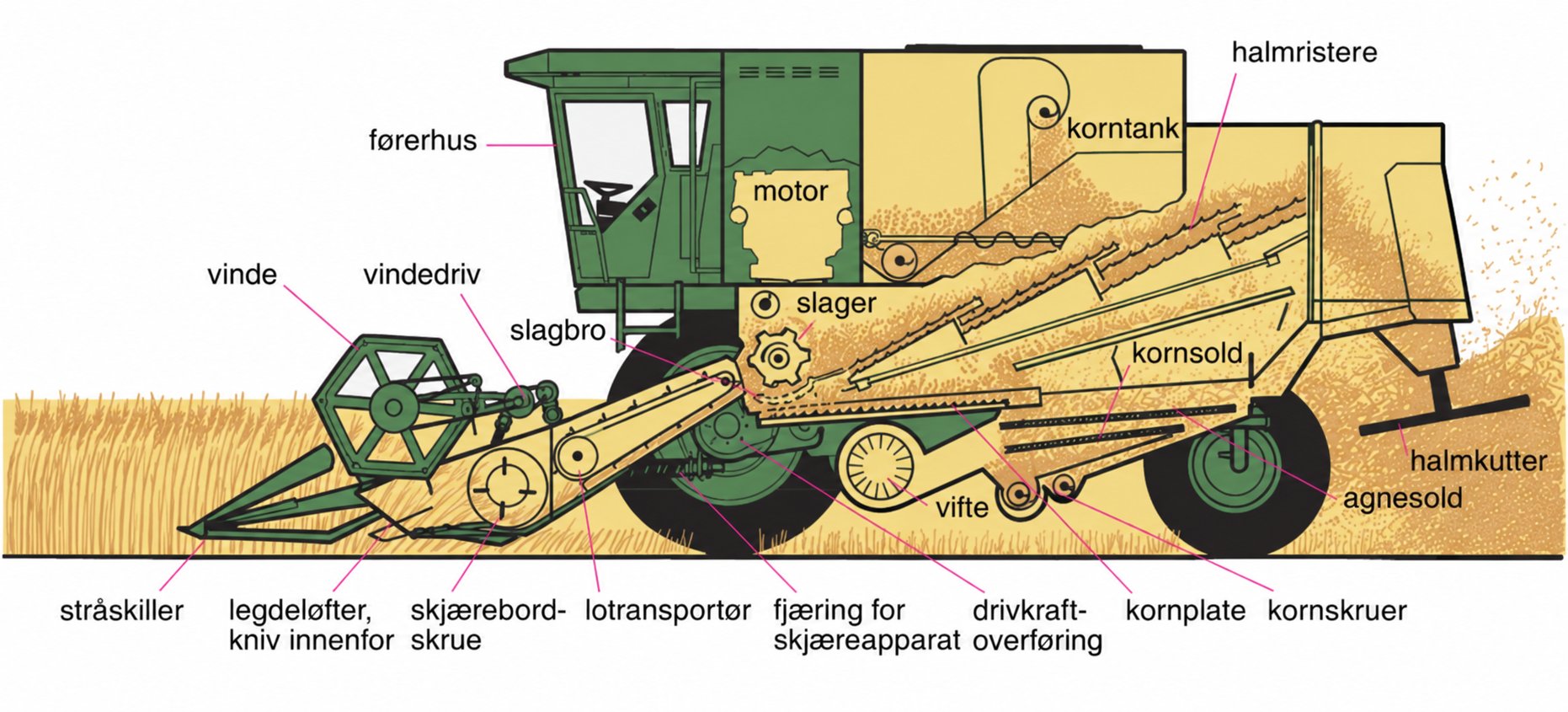
With trailed combines, and later self-propelled ones, the threshing machine was phased out. The harvest became easier, less exhausting and needed fewer hands. For a time we had two trailed combines on the farm, which needed two tractor drivers, two men for bagging and at least two for loading, carting and storing the sacks.
In the mid-1960s we got the first self-propelled combine on the farm, of the same make as before – «Aktiv». It had a wider cutting table and was probably somewhat improved mechanically. It replaced two trailed combines, but the grain was still stored in sacks. It was mainly Nils Johan Heieren and «Skaug'ern» (Johannes Skaug) who were trusted to drive the combine, and later Finn Erik Bøvolden and my brother Johan.
Then came the first combine with a tank, and the jute sacks became a thing of the past. This required a grain dryer and storage. The first dryer was built in the workshop loft. Two big fans sent air into ducts in the middle and then through a perforated floor in four large bins on both sides. I remember the building of the dryer, mostly as «labourer» for Kristian Sveen. I pestered him into giving me some Oliver Twist (chewing tobacco that looked like liquorice) – and was ill for the rest of the day!
The grain was tipped into a chute leading to a Kongskilde blower, which blew it through pipes up to the bins. This blower was an Achilles' heel, as it kept clogging. I think I spent many hours «nursing it» every autumn. The pipes also had to be moved and the grain spread in the bins. It was a fair bit of work, but nothing compared with standing in «the hen's backside» of the old thresher!
When the farm passed from my father to my brother Johan, a new hot-air dryer was built at the south end of the workshop building. This increased both drying and storage capacity, and meant one could «afford» to harvest slightly damper grain.
Today two men (one on the combine and one carting grain) do most of the harvest, in stark contrast to the hands needed for binding, stooking, carting and running the threshing machine.
As the fields were harvested, the straw was mostly baled for feed (usually alkali-treated) for the cows and young stock. Some of the straw was also burned in the fields. This was exciting, and revealed small pyromaniac tendencies in quite a few of us. The burning eventually stopped as people became more aware of the air pollution it caused.
Even though I have now reached «adult age» and have not lived on the farm since I was 20, my ties to the farm and the family there have lasted, and I often take pleasure in memories of growing up on the farm and everything connected with the work. Back then it was teeming with life, with many employees and many children on the farm, and I found that time both exciting and formative for me personally. Many of the memories are also tied to the people who worked on the farm. I hope this text can give a glimpse of the joy and fascination of both the technical and the social life on the farm in my childhood – here with a focus on one particular part of the farming year: the harvest.
— Tore Mellbye